

Information about finned heat exchangers
Release time:
2022-03-16 10:59
Source:
www.winasia.cn
The following is a brief introduction to finned heat sinks led by me.
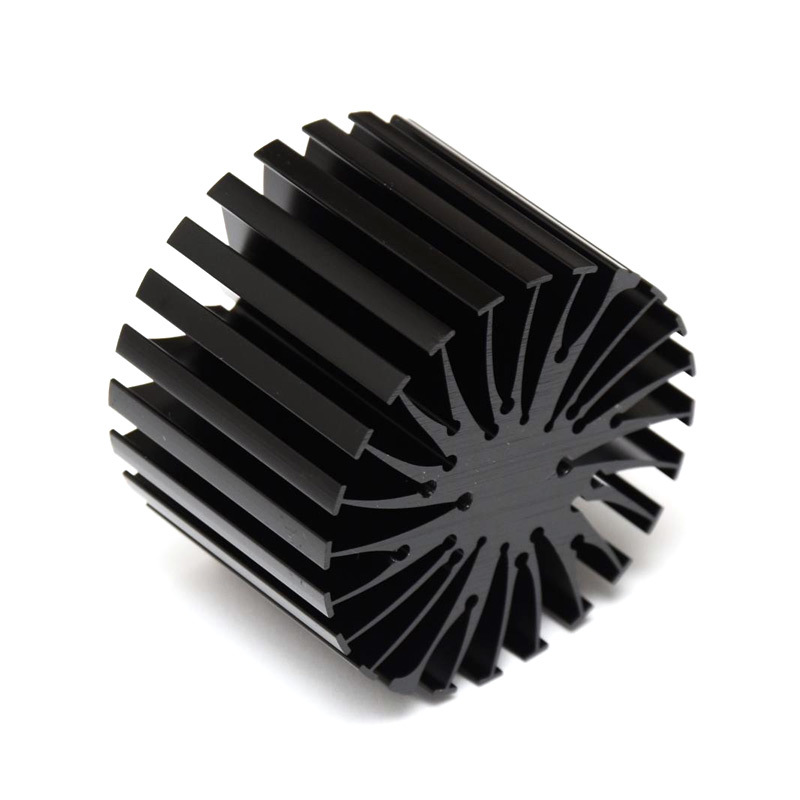
Finned heat sinks are commonly used in our LED lighting fixtures. Why? Firstly, they are cost-effective, and secondly, they are easy to process. There are also variants of finned heat sinks, which strictly speaking also belong to the category of finned heat sinks.
I will discuss the materials I have encountered with finned heat sinks (I will not mention other composite materials as they are too extensive). The materials include aluminum, followed by iron, and then copper. Copper is rarely used due to its high cost, which manufacturers do not allow. There are two types of processes: forging and extrusion. Examples will be provided below.
Forging process:
The forging process involves heating aluminum blocks and filling molds under high pressure. Its advantages include a fin height of over 50 mm and a thickness of less than 1 mm, allowing for a large heat dissipation area within the same volume. Forging can easily achieve good dimensional accuracy and surface finish. However, due to the low plasticity of metals during forging, cracking can easily occur during deformation, requiring high resistance to deformation and large tonnage (over 500 tons) forging machines, which leads to high equipment and mold costs, resulting in very high product costs.
Extrusion process:
Aluminum has been used in the heat sink market for a long time due to its softness and ease of processing. Simply put, aluminum extrusion technology involves heating aluminum ingots at high temperatures, allowing molten aluminum to flow through a grooved extrusion die under high pressure to create rough heat sink blanks. These blanks are then cut and slotted to form the heat sinks we often see. Aluminum extruded fins are low in cost and have a low technical threshold. However, due to material limitations, the ratio of thickness to length of the fins cannot exceed 1:18. It is difficult to increase the heat dissipation area within limited space, resulting in poorer heat dissipation performance for aluminum extruded fins.
From the above, we can see the differences between the two types of heat sink structures. Extrusion is relatively simple, while die casting can create complex shapes. Of course, we should not only judge the quality of heat sinks based on their type. We should choose those with a high cost-performance ratio rather than just opting for the best ones. In the end, the effect remains the same. Isn't that a waste?
Dongguan Yongya Hardware Electronics Co., Ltd. is a wholly foreign-owned enterprise located in Wanjiang Industrial City, Dongguan City, with very convenient transportation. The company was established in 1997 and has rapidly developed over several years, now possessing fixed assets of 25 million Hong Kong dollars. The factory covers an area of 25,000 square meters with fragrant flowers and an elegant environment where work is orderly.
The company mainly produces various aluminum profiles, speaker DVD front panels, various heat sinks for computers and audio equipment, and anodizing processing.
Our company integrates mold design, development, and manufacturing with strong technical capabilities and advanced machining and production equipment; we have rich experience in hardware product manufacturing; we possess sufficient capacity for hardware product processing and are one of the fastest-growing hardware product factories in Dongguan.
The operators of the company focus on the future by actively learning advanced management practices and introducing advanced technologies while emphasizing talent skill development. The company has fully established an ISO9001:2015 quality management system and an ISO14000:2015 environmental management system. In 2018, our company was the first in the industry to pass safety production standardization certification.
We adhere to the principle of "customer-centricity, continuous improvement, excellence, total quality management by all employees, and timely delivery" to meet customers' growing demands for quality and technology while providing high-quality services at low costs to win customer satisfaction and praise.
We firmly believe that our quality can ensure your 100% satisfaction and that our products can give you 100% peace of mind. We look forward to long-term cooperation with you to create a better future together.
Next, I will lead everyone to have a brief understanding.Finned heat sink.
The heat sink that is more commonly used in our LED lighting isFinned heat sink. Why? First, the cost is low, and second, it is easy to process. Of course, there are also variants of fins, which strictly speaking also belong to finned heat sinks.
The materials I have come into contact with for finned heat sinks (here I only mention what I have encountered, other composite materials will not be discussed as they are too complex). The comparison is aluminum, then iron, and then copper. Copper is rare because its cost is very high, and manufacturers will not allow it. There are two processes: forging and extrusion. The following examples will be given separately.
Forging process:
The forging process is formed by heating aluminum blocks and filling molds with high pressure. Its advantages include a fin height of over 50 mm, a thickness of less than 1 mm, and a large heat dissipation area for the same volume. Forging easily achieves good dimensional accuracy and surface finish. However, in forging, due to the low plasticity of metals, cracking is easy during deformation, and it requires a large tonnage (over 500 tons) forging press. The high cost of equipment and molds also leads to extremely high product costs.
Extrusion process:
Aluminum has been used in the heat sink market for a long time due to its softness and ease of processing. Simply put, aluminum extrusion technology involves heating aluminum ingots at high temperatures, allowing molten aluminum to flow through a grooved extrusion die under high pressure to form rough heat sink blanks. These blanks are then cut and slotted to create the heat sinks we often see. Aluminum extruded fins are low in cost and have a low technical threshold. However, due to the limitations of the material itself, the ratio of thickness to length of the fins cannot exceed 1:18. It is difficult to increase the heat dissipation area in limited space; therefore, the heat dissipation effect of aluminum extruded fins is relatively poor.
From the above, we can see the differences between the two types of heat sink structures. Extrusion is relatively simple, while die casting can create complex shapes. Of course, we cannot judge the quality of heat sinks solely based on this. We should choose those with high cost performance rather than just using the best ones everywhere. In the end, the effect is still the same. Isn't that wasteful?
Dongguan Yongya Hardware Electronics Co., Ltd.is a wholly foreign-owned enterprise located in Wanjiang Industrial City, Dongguan City, with very convenient transportation. The company was established in 1997 and has rapidly developed over several years, now owning fixed assets of HKD 25 million. The factory covers an area of 25,000 square meters, with fragrant flowers and an elegant environment where work is orderly. The company mainly produces various aluminum profiles, audio DVD front panels, various heat sinks for computers and audio equipment, and anodizing processing. This company integrates mold design, development, and manufacturing; it has strong technical capabilities and advanced machining and production equipment; it has rich experience in hardware product production; it has sufficient capacity for hardware product processing and is one of the fastest-growing hardware product factories in Dongguan area. The operators focus on the future by actively learning advanced management practices and introducing advanced technology while emphasizing talent skill development. The company has fully established ISO9001:2015 quality management system and ISO14000:2015 environmental management system. In 2018, the company was the first in its industry to pass safety production standardization certification. We adhere to the principle of 'customer-centered, continuous improvement, striving for excellence, all-staff quality control, timely delivery' to meet customers' growing demands for quality and technology while providing high-quality and low-cost services to customers, winning their satisfaction and praise. We firmly believe that our quality can make you 100% satisfied and our products can give you 100% peace of mind. We look forward to long-term cooperation with you to create a better future together.
Related News
Applications and Prospects of Fin Heat Sinks in Electronics
Explore the importance of fin heat sinks in modern electronic devices and their future development trends.
Application fields of heat sinks
As an indispensable part of the thermal management system, radiators have a wide range of applications.
How much do you know about finned heat sinks?
The characteristics of finned heat sinks are that the fins break through the original proportional limitations, resulting in good heat dissipation effects, and different materials can be used to make the fins. The drawbacks are also quite obvious, as the heat sink and the base are bonded with thermal paste and solder, which can cause interface resistance issues that affect heat dissipation. To improve these shortcomings, two new technologies have been applied in the field of heat sinks.
Introduction to the characteristics of finned heat sinks.
The finned heat sink is a device used for electronic components that are prone to heating in electrical appliances. It is made of aluminum alloy, yellow or bronze, and comes in plate, sheet, or multi-sheet shapes. For example, the CPU in a computer requires a considerable size, and the power tubes, line tubes, and amplifier tubes in televisions all need to dissipate heat. Typically, a layer of thermal grease should be applied to the contact surface of the electronic components to more effectively conduct the heat generated by the components, which is then dissipated into the surrounding air.
Introduction to the advantages of finned heat sinks
The finned heat sink primarily achieves heat dissipation through conduction, involving dielectric heat sinks that are in direct contact with the processor. After absorbing heat, it dissipates through convection. During the convection process, the area is mainly determined by the surface area of the fins. Common methods used in the industry include: increasing the number of fins and increasing the length of the fins. One of the reflected data points is the 'thickness ratio', which is the ratio of fin thickness to its height.
Introduction to finned heat sinks
The finned heat sink primarily achieves heat dissipation through conduction, involving a medium heat sink that is in direct contact with the processor. After absorbing heat, the heat sink dissipates it through convection. In the convection heat dissipation process, the heat dissipation area is mainly determined by the surface area of the heat dissipation fins. The larger the surface area, the better the heat dissipation effect. The smaller the surface area, the worse the heat dissipation effect.

Privacy Policy | SEO | CitySite | Support:300.cn Dongguan